

On the surface structural demolition may look like wrecking a building; it is actually an engineering process which seeks to prioritize any residual value left in a property while minimizing harm to people, property, and the environment and allowing for reuse of the site. For civil engineers and senior students, demolition helps to converge all components of analysis, sequencing, and execution in the field. Read more on this page.
Load Analysis Before Demolition
The start of safe demolition is to define an as-is structural model of the system not solely the original plan. Engineers are to analyze record drawings, scan the concrete, and note any changes such as cut openings, direct or indirect areas of corrosion, fire damage, undocumented reinforcement and anything else that indicates deviation from the drawings. The as-is model allows for progressive collapse checks so any temporary cuts or lifts do not initiate unintentional failure modes.
Staging is everything above all else. The group identifies primary load bearing elements that are critical to the loads imposed, sequences their removal, the need for temporary works such as bracing etc. while allowing the load path to remain intact and reliable at every stage of the project. For concrete, residual capacity is checked where bars are discontinuous or may comply with post-tensioning. For steel, there is consideration for how connections might behave under reversed or eccentric loading. Intermediate wind and live loads often control the analysis – this may be the case in a partial state design in particular in regard to tall frames.
There are two enabling tasks to allow the analysis to be actionable. The requirements for preparing the site for demolition will govern how to provide access, laydown, separation from neighbours etc., but the disconnection of utilities and any other controlled inflows is also crucial in avoiding energized hazards, and uncontrolled inflows that could undermine slabs or excavation sites; we would not want to undertake demolition sequentially and rely upon the entire separation approach to have gone well. Both tasks require verification by permits and lock-out/tag-out before the first concrete is broken and structural element is moved.
Controlled Collapse Techniques
Finally, when systematic dismantling through piece-by-piece demolition is no longer an option, the aim is to control the structure’s movement to deliver a planned collapse mechanism which can be bounded. This may involve calculations to develop pre-weakening patterns, hinge locations, and energy dissipation so that the footprint remains within exclusion zones. Vibrations, air overpressure, and flying debris near sensitive neighbors are quantified, and dust control (https://www.epa.gov/system/files/documents/2021-11/bmp-dust-control.pdf) plans are built in.
Field controls bring monitoring-surveys for drift, geophones for vibration, real-time monitoring cameras for sequencing; with that infrastructure, some of the commonly engineered operations include:
- Pre-cutting selected web and flange locations to create predictable plastic hinges during pull-down.
- Cable pulling with synchronized winches to tip-sequence a framed bay in a planned direction (the aim of course being to verify at every increment).
- Hydraulic jacking to unseat girders, and then relying on gravity completed the movement as the structure lives in an identified and secured zone.
- Linear charges, or mechanical shears, to cut selected pieces after redundancy has been removed, with time delays to avoid sympathetic failures.
Engineering Safety Protocols
Safe is not improvised; safety is engineered. The engineering starts with a hazard inventory: Unstable masonry, corroded connections, unknown post-tensioning, ACM’s, lead paint, and confined spaces. For each hazard, there is a corresponding control (remove, isolate, or constrain) are documented in the method statement and job hazard analysis.
Temporary works are the framework for safe sequencing. Shoring and bracing creates stability for compromised framing members (frames, stair cores, and facade segments) that must remain until adjacent work is complete. Systems are engineered to consider eccentric and out- of-plane loads imposed by partial removals, including capacity checks for equipment surcharge and wind. Access routes are planned to avoid work under suspended loads, and tagging (green/yellow/red) is used to communicate an area’s status.
Monitoring-this ties it all together. Trigger action response plans set thresholds for tilt, vibration, and settlement. If instrumentation exceeds predefined thresholds, the operation is stopped and the sequence or interim work is re-evaluated. Fire safety in relation to hot-work permits, watches, spark protection, and active standpipes remains as prescribed by code.
Equipment Selection Criteria
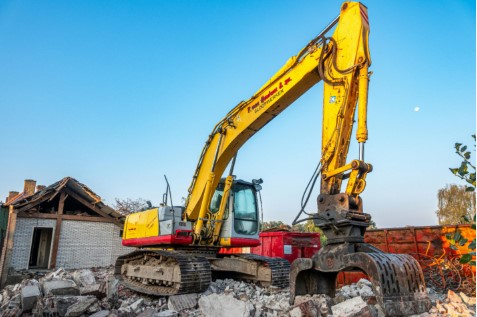
Equipment must be appropriate for the engineered method. All classes of excavators, boom lengths and tools will induce loads, reach distances and provide with different pre-conditions for fatigue. Shears, breakers, and pulverizers are used depending on the impulse characteristics of their design; mishandling the wrong tool can equally over stress a slab that is only partially supported. It will also be affected by procurement in terms of how the debris will be processed, tipping fees and obtaining permits in the locality.
Coordination with a trusted urban contractor—such as a construction company Philadelphia partner for city jobs—helps align gear with noise windows, traffic control, and waste diversion targets.
Before committing the fleet, the engineering team will take into consideration the ground bearing pressures, any overhead conflicts that may occur, and the noise and vibration limits. Common selection variables will include:
- Tool-structure compatibility (shear forces versus section capacity, breaker energy versus slab thickness)
- Reach and means of orientating control to socially distance operators from the exclusion zones.
- Machine weight versus slab capacity with load-spread mats where applicable.
- Contingency for redundancy as a critical lift and the spare tools to deal with obstructions.
Case Studies of Engineered Demolitions
An example of a concrete hotel being demolished in a downtown location sitting next to a transit tunnel. The demolition team continued with a top down sequence to remove unknown or significant loads and protect it from vibration. Floor loads under the mini-excavators and mobile cranes were checked to acceptable loads on the temporary grillage. Release cores on floors slabs allowed with the monitored removal of the beams on a contractually and engineered controlled process, while monitoring verified the operational settlement on the tunnel was below action limits set.
An example of an aging steel arena remained on an urban site one bay away from an adjoining medical facility. In the end, implosion was not an option. The engineers matched a controlled and progressive collapse sequence by pulling down the roof truss with cables after a selective removal of bracing. The pre-weakening process created hinge lines that allowed the roof to collapse inward, using arrays of water mist to control dust. The remaining bowl was peeled with high-reach excavators, while also observing noise and air permitting and desired neighbour time to start their foundation.
The examples referenced reinforce a common theme: demolition is as detailed and planned as new construction with less certainty. When all of the created model, sequencing, safety methods and equipment selections are aligned, the more complex structures come down, and the subsequent phase can be undertaken confidently.
